Kansas pharmacies celebrate PBM reform passage
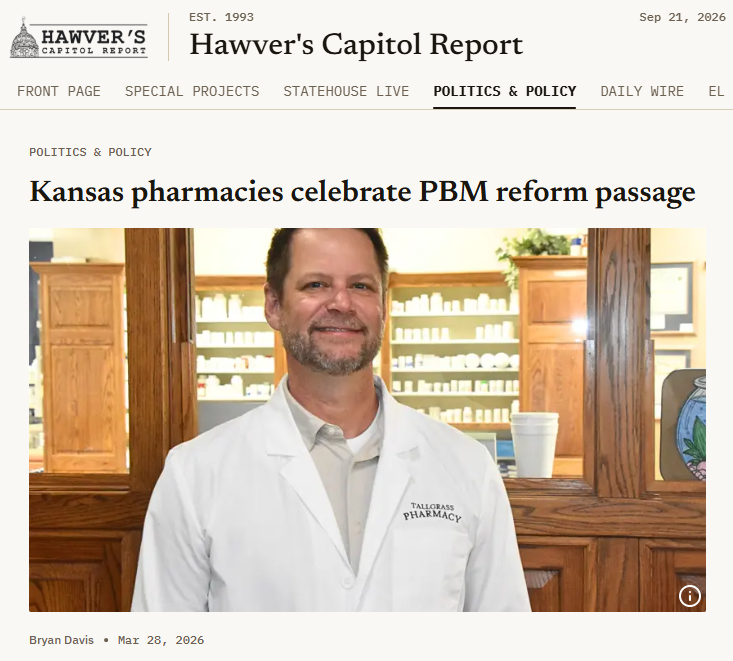
Kansas earlier this week joined a handful of states to pass extensive pharmacy benefit manager reform.
Senate Bill 20, which began life as Senate Bill 360 in late January, is one of multiple PBM reform bills being debated in statehouses across the country this year. The legislation seeks to improve transparency for pharmacies, procedures for pharmacy audits and also to level the playing field financially for independent practitioners.
The bill, which received bipartisan support in both chambers — passing the House Monday night by a 104-17 vote and then the Senate on Tuesday by a 32-8 margin — now heads to the desk of Gov. Laura Kelly.
Proponents, led by independent pharmacy owners, lauded lawmakers for joining states like Arkansas and West Virginia, which already passed similar bills.
“We’ve been at this for a long time,” Joseph Gilliland, owner of multiple small pharmacies in northeast Kansas, told State Affairs this week. “Probably the biggest piece of pharmacy legislation that we’re gonna see pass through.”
Gilliland, working with the Kansas Pharmacy Association, has for years pushed PBM reform in Kansas.
Kansas businesses, labor unions and public employers rely on PBMs to manage their prescription drug benefits and save money, Andrew Wiens, who spoke on behalf of Kansas Employers for Affordable Healthcare, told State Affairs in an email this week. The organization spoke in opposition to the PBM reform bill this session.
“PBMs save employers money by negotiating price concessions with drug manufacturers, requiring pharmacies to compete on price and quality, managing formularies to favor generics and lower-cost brand drugs, reducing waste and abuse and helping patients adhere to their medications,” Wiens said. “Without the entities with expertise in using these tools, costs would almost certainly be higher for employers and employees.”
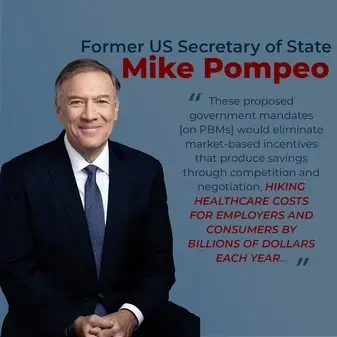
Other opponents, including the Pharmaceutical Care Management Association, say that the bill, if it becomes law, will result in increased drug and health care premium costs.
The bill mandates that PBMs use the National Average Drug Acquisition Cost (NADAC) to set reimbursement rates, and they also must pay a $10.50 dispensing fee to Kansas pharmacies each time a prescription is filled, a “price control” measure that opponents say will be passed on to employer health plans in the form of a “pill tax.”
PCMA Senior Director of State Affairs Jonathan Buxton told lawmakers during March 11 testimony that the dispensing fee could result in as much as $78 million in “excess drug spending.”
PBMs may pay the dispensing fees, but the cost will ultimately be passed to consumers, Wiens said.
“As with any other tax or price control scheme, the pill tax will end up being paid by the payers: in this case, employers with health plans and their employees,” he said. “The pill tax is a new cost in the system that will be paid to pharmacies regardless of market conditions, efficiency or negotiated pricing.”
Additionally, Wiens said patients may feel the cost at the pharmacy counter as well.
“Patients are subject to paying the additional $10.50 up to the out-of-pocket maximum contemplated by their health plan,” he said. “Patients currently using low-cost generics or high-deductible health plans will likely face the highest new out-of-pocket costs at the pharmacy.”
Proponents have long downplayed the impact of increased dispensing fees, and they say that the adjusted reimbursement rates for drugs mandated in the bill are long overdue.
Gilliland said the goal is not to put PBMs out of business. It’s to level the playing field.
“PBMs aren't bad,” Gilliland said. “They have just kind of got too big for their shoes. They do a very good job of processing claims. When you come into the pharmacy, we can process that claim instantaneously. At the point of sale, we know what we're getting reimbursed, what your copay's gonna be, and they do that very well.”
A substantial number of prescriptions filled in the United States are managed by the half dozen largest PBMs, which has led to accusations of monopolistic practices when it comes to directing health plans and deciding drug coverages and reimbursements to pharmacies.
Many of the proponents who testified on behalf of the original SB 360 were independent pharmacists who say closures of pharmacies in rural counties have increased because of the impact of PBM practices.
PBM reform legislation has been introduced at the federal level, but Gilliland said it is moving slowly, something that has prompted states like Kansas and Tennessee to accelerate their own bills in their statehouses.
“The problem is if we wait on the federal legislation to come through, it'd be too little, too late,” he said. “This is the bottom line.”
The “poison pill”
SB 20’s dispensing fee was the No. 1 hangup this week for some Kansas House members, who praised the transparency part of the bill during Monday’s debate, but decried the “tax” they said will be passed down to employers and employees at some point.
“I am all for transparency, but I am not for the poison pill of $10.50,” said Lauren Bohi, R-Olathe, as she made an unsuccessful motion on Monday to send SB 20 back to a conference committee.
Had the motion passed, the likelihood that the bill would have returned to the floor would have been slim.
That’s a story all too familiar to Gilliland, who has seen PBM reform bills in years past be introduced, gain momentum and then die.
“And every year we've gotten a little smarter and a little smarter and a little more aware…of the process…and how everything's working,” he said.
Last session, he said that a PBM reform bill’s language was changed without anyone’s knowledge two days prior to a potential vote.
This year, the legislation changed bill numbers within the Senate and bounced between multiple House committees.
There were also a lot of moving parts to the legislation, Gilliland said.
“There's a lot in this bill,” he said. “When you have an opportunity, you want to get as much out of it as you can, but also you don't want to complicate it too much.”
A packed bill did increase the risk of another conference committee delay on Monday. Had that happened, days before the session’s first adjournment was scheduled, it might have killed the bill for good.
“If it would have went back to committee, it would have been dead,” Gilliland said. “When I was watching that, and they motioned to send it back to committee, I was like, ‘if this happens, we're done.’”
Bohi’s motion failed 27-93.
She was later one of the 104 House members to vote in favor of the passage of SB 20.
Independents’ day
One pharmacist in rural Kansas knows just about every person who walks through the doors of his small business to get a prescription filled.
His independent pharmacy is located on the main drag of a town of less than 5,000 people.
He has owned the business for over two decades, but at the end of this month, he will hand the keys over to another proprietor.
His decision to sell his business was not made lightly. It follows years of decreased revenue and profits he said are due to unfair practices by PBMs.
“I'm exhausted, trying to survive economically,” he said, requesting not to be identified due to his ongoing contracts with PBMs. “Because…the deal gets worse every year. And if we're being paid at cost, then I'm paying to keep the store open. I'm paying to fill prescriptions.”
At one time, there were 15 employees at the small business, a lot for a rural community storefront. Today, that number has dwindled to one full-time employee.
Still well short of retirement age, he said the sale will allow him to clear his debts, with plans to continue working.
Many independent pharmacies across the state are facing similar business decisions. In rural counties, where there is one or even zero pharmacies, the impact of closures on patients will be felt the most, Gilliland said.
“You’re going to start having gaps in coverage,” he said, adding that mail-order prescription services may not be able to fill all of those gaps.
Gilliland’s family business has operated in Kansas for a half century. His father was a pharmacist, and his son and niece are currently in pharmacy school.
He owns Medical Pharmacy in Holton and the business has grown over the years to include locations in Onaga, Westmoreland and Topeka. Gilliland said that he employs right around 50 people within those stores.
Gilliland said that his son wants to carry on the family’s legacy and run an independent pharmacy.
Part of doing that means staying involved politically, he said.
“(My son) went with me to Legislative Day, and he's like, ‘I had no idea that there's this much going on,’” he said. “And my biggest thing for him was, I said, ‘you know, if you're not at the table, it probably means you're on the menu…’ That is why it is so important to be involved in your profession, you know, 'cause if you're not there, somebody else is gonna make the decisions, and they're probably not gonna be good for you. Probably good for them.”
Staying involved seems to have paid off this week for Gilliland and other independent pharmacists in Kansas.
Some lawmakers called the bill’s passage a “David vs. Goliath” outcome.
If SB 20 becomes law, things could improve for dozens of small businesses teetering on the edge of closure.
“It’s going to change the way we practice pharmacy,” Gilliland said. “It’s not only a bill that is a big win for pharmacists, it’s a big win for the constituents. It truly is.”
As for other small businesses, it’s unclear how employer-sponsored health care plans might be affected by the trickle-down effect of dispensing fees.
Gilliland said that he hopes the recent legislation will draw the PBM industry to the table to craft better drug and health care policy.
As for KEAH, Wiens said, “we are always happy to discuss solutions that improve our prescription drug market without raising costs for Kansas employers and employees and their families.”
That could include “encouraging competition in the prescription drug marketplace; addressing patent abuse by manufacturers; breaking down barriers to mail-order pharmaceutical delivery, biosimilar innovation, and use of generics; and expanding market-based solutions.”
—
Bryan Davis is the managing editor of State Affairs Kansas/Hawver's Capitol Report. He can be reached at bdavis@stateaffairs.com.